What Florida Homeowners Need to Know About Heat Pump vs Traditional System Cost Comparison
The heat pump vs traditional system cost comparison comes down to more than just the sticker price. For Melbourne, FL homeowners, the right system can mean real savings over time — or a surprisingly costly mistake if you choose based on upfront cost alone.
Here's a quick breakdown to answer the core question:
| Factor | Heat Pump | Traditional AC + Gas Furnace |
|---|---|---|
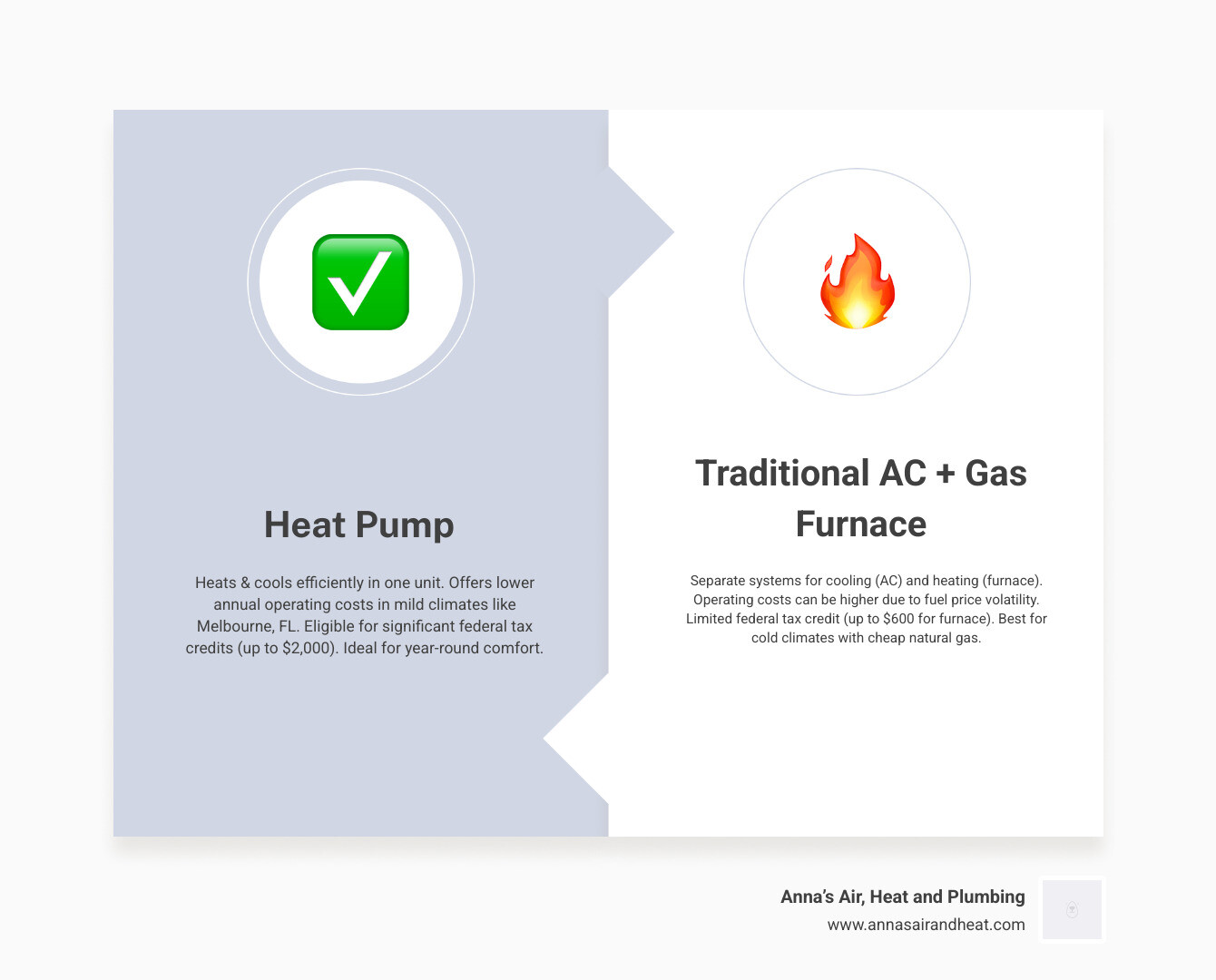
| What it does | Heats and cools in one unit | Separate systems for heating and cooling |
| Upfront cost | Comparable to replacing both systems | Lower if replacing AC only |
| Annual operating cost | Lower in mild climates like Melbourne | Can be higher, depending on fuel prices |
| Federal tax credit (2026) | Up to $2,000 | Up to $600 (high-efficiency furnace only) |
| Best climate fit | Mild to moderate winters | Cold climates with cheap natural gas |
| Lifespan | 15–20 years | 15–20 years (furnace); 12–15 years (AC) |
| Maintenance | One system to maintain | Two systems to maintain |
Melbourne's climate changes the math significantly. Winters here are short and mild — average lows stay in the 50s and 60s, with hard freezes happening only a handful of nights per year. That's exactly the condition where heat pumps shine. They move heat instead of generating it, which makes them two to three times more efficient than electric resistance heating during those cooler months.
In short: for most Melbourne-area homeowners, a heat pump is the stronger long-term value. But the details — your home size, existing equipment, local energy rates, and available incentives — determine exactly how the numbers shake out for your situation.
Upfront Investment: Heat Pump vs Traditional System Cost Comparison
When we sit down with families in Cocoa Beach or Viera to discuss a new AC Installation, the first hurdle is often the initial purchase price. It is a common misconception that heat pumps are drastically more expensive than traditional systems. In reality, when you look at the heat pump vs traditional system cost comparison, the "sticker shock" is often a result of comparing apples to oranges.
A traditional Air Conditioning unit only cools. To stay warm during those few chilly Merritt Island nights in January, you also need a separate Heating source, usually a gas furnace or electric heat strips. A heat pump, however, is a two-for-one deal. It handles both jobs using a clever component called a reversing valve.
The Magic of the Reversing Valve
In the summer, your heat pump acts exactly like a standard air conditioner, pulling heat out of your home and dumping it outside. When the temperature drops, that reversing valve flips the script. Instead of pulling heat from inside, it extracts warmth from the outdoor air (yes, even when it feels cold to us, there is still usable heat energy out there!) and pumps it into your living room. Because it's moving heat rather than creating it through combustion or high-resistance electricity, it is incredibly efficient.
Installation Complexity and Equipment Availability
As of April 2026, the HVAC industry has fully embraced the transition to lower-GWP (Global Warming Potential) refrigerants, such as R-32 and R-454B. These newer refrigerants are more environmentally friendly and are now the standard for all new Heating Installation projects.
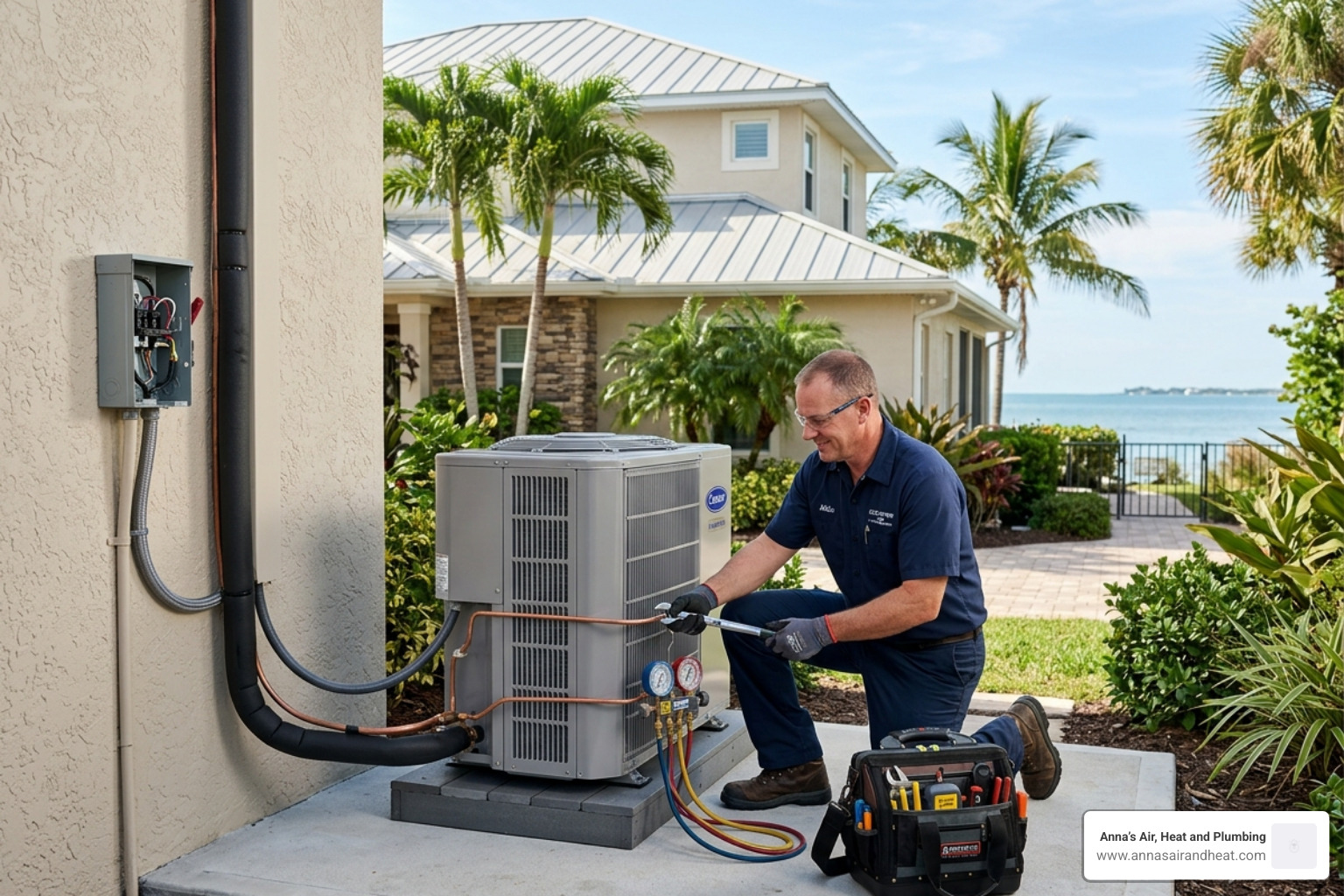
While a heat pump might require slightly more complex wiring or a larger electrical circuit than a simple AC-only swap, the installation labor is often offset by the fact that we are only installing one outdoor unit instead of managing both a condenser and a gas line for a furnace. In many Melbourne neighborhoods where natural gas isn't even an option, the choice becomes even simpler: a heat pump vs. an old-school electric furnace. In that matchup, the heat pump wins on value every single time.
Maximizing Value with 2026 Incentives and Tax Credits
One of the biggest shifts in the heat pump vs traditional system cost comparison over the last few years has been the massive boost from federal and state incentives. Thanks to the Inflation Reduction Act, the financial "math" for homeowners in Rockledge and Satellite Beach has fundamentally changed.
Section 25C Federal Tax Credits
In 2026, the federal government continues to offer substantial support through the Section 25C Energy Efficient Home Improvement Credit. For homeowners who choose a qualifying high-efficiency Heat Pumps system, you can claim a tax credit of up to $2,000. Compare that to a traditional high-efficiency gas furnace, which usually only qualifies for a $600 credit. This $1,400 difference alone often bridges the gap in upfront equipment costs.
State Rebates and HEEHRA
Beyond federal tax credits, Florida homeowners may have access to point-of-sale rebates through the High-Efficiency Electric Home Rebate Act (HEEHRA). These are often income-dependent and can provide several thousand dollars in instant savings for eligible households. When we combine these with local utility incentives — like those sometimes offered by FPL for high SEER2-rated equipment — the net cost of a heat pump can actually end up being lower than a traditional AC and furnace combo.
Understanding the Ratings: SEER2 and HSPF2
To qualify for these top-tier incentives, the system must meet specific energy efficiency tiers:
- SEER2 (Seasonal Energy Efficiency Ratio 2): This measures cooling efficiency. In Florida, we look for high SEER2 ratings to keep those August electric bills under control.
- HSPF2 (Heating Seasonal Performance Factor 2): This measures heating efficiency. Even though our winters are mild, a high HSPF2 rating ensures that when you do need heat, you’re getting it for the lowest possible cost.
Long-Term Savings and Heat Pump vs Traditional System Cost Comparison
We always tell our neighbors in Indialantic that the real cost of an HVAC system isn't what you pay the day it's installed; it's what you pay over the next 10 to 15 years. This is where the heat pump vs traditional system cost comparison truly leans in favor of modern electric technology.
10-Year Total Cost of Ownership
Research shows that a high-efficiency inverter heat pump can save a homeowner roughly $8,500 over a 10-year period compared to a traditional gas furnace and AC setup in a moderate climate. In a place like Melbourne, where we use the cooling side of the system for 10 months of the year, those efficiency gains add up fast.
Maintenance and Lifespan
A common question we get is: "Does a heat pump wear out faster because it runs year-round?" It's a fair concern. However, in Florida, your AC was already going to run for the vast majority of the year. Adding a few hundred hours of heating time in the winter doesn't significantly shorten the lifespan compared to a traditional AC. Both systems typically last between 15 and 20 years if they receive regular HVAC Maintenance.
In fact, maintaining one system is often simpler and more cost-effective than maintaining two. With a traditional setup, you have a furnace with burners, gas valves, and heat exchangers that need safety checks, plus an outdoor AC unit. With a heat pump, our technicians focus on one cohesive system.
The 50% Rule: Repair vs. Replace
If you are currently nursing an older unit along, you should consider The 50% Rule: When To Stop Repairing And Start Replacing Your Florida AC. If a repair costs half as much as a new system, or if the system is over 10 years old and frequently breaking down, the long-term savings of a new heat pump will far outweigh the "band-aid" cost of another repair.
Operational Efficiency in the Florida Climate
Melbourne is a unique place to live. We have beautiful beaches, but we also have salt air and humidity that can be brutal on machinery. When evaluating the heat pump vs traditional system cost comparison, we have to look at how these systems handle the "Florida Factor."
Humidity Control: The Secret to Comfort
In Brevard County, comfort isn't just about the temperature; it's about the moisture in the air. Modern heat pumps, especially those with variable-speed inverter compressors, are world-class at dehumidification. They can run at lower speeds for longer periods, constantly pulling moisture out of your home without over-cooling it. This makes your home feel cooler at a higher temperature, allowing you to nudge the thermostat up a couple of degrees and save even more on your power bill.
Why Heat Pumps are Perfect for Melbourne
We’ve written extensively about Why Heat Pumps Are Perfect For Melbourne, FL Homes: Energy Savings, Comfort, Coastal Climate Benefits. Because our winters rarely see temperatures drop below 40 degrees, a heat pump stays in its "sweet spot" of maximum efficiency almost the entire season. Unlike homeowners in the North who might need to rely on a furnace when it hits sub-zero, our HVAC systems can easily pull enough heat from the 50-degree Florida air to keep your bedroom a cozy 72 degrees.
Energy Rates and Heat Pump vs Traditional System Cost Comparison
The "fuel" you use to run your home is a major variable in the heat pump vs traditional system cost comparison. In our part of Florida, electricity is the dominant energy source, and natural gas infrastructure is not available in every neighborhood.
Electricity vs. Natural Gas
If you have to pay to have a gas line run to your house just to install a furnace, the upfront cost of a traditional system skyrockets. Even if you already have gas, the price of natural gas can be volatile. Electricity prices, while they do fluctuate, are often more stable in the long run as Florida continues to diversify its power grid with more solar energy.
The "Dirty Secret" of Auxiliary Heat Strips
When looking at operating costs, we have to mention auxiliary heat strips. Most heat pumps in Florida are equipped with these electric "backup" heaters for those rare nights when the temperature drops near freezing. These strips are essentially a giant toaster inside your air handler. They are effective but use a lot of power.
The trick to keeping your costs low is ensuring your system is sized correctly so that those heat strips rarely have to turn on. A properly installed, high-efficiency system will use its "heat transfer" technology (measured by its COP or Coefficient of Performance) to stay efficient down to very low temperatures without needing the backup strips.
| Metric | High-Efficiency Heat Pump | Standard Electric Furnace |
|---|---|---|
| COP (Efficiency) | 2.0 – 4.0 (200-400% efficient) | 1.0 (100% efficient) |
| Annual Heating Bill | Lower (Moves heat) | Higher (Creates heat) |
| Comfort Level | Steady, dehumidified air | Very dry, hot air |
Choosing the Right Configuration for Your Home
No two homes in Palm Bay or Merritt Island are exactly the same. The heat pump vs traditional system cost comparison for a 1,200-square-foot condo will look very different than for a 3,500-square-foot waterfront estate.
The Importance of a Manual J Calculation
We don't believe in "rule of thumb" sizing. To maximize your savings, we perform a Manual J load calculation. This takes into account your home’s square footage, insulation levels, window orientation, and even the local shade trees. An oversized system will "short cycle," leading to high bills and humid air, while an undersized system will struggle to keep up.
Dual-Fuel and Hybrid Options
For some homeowners, a "hybrid" or dual-fuel system is the answer. This pairs a heat pump with a gas furnace. The heat pump handles the bulk of the work during our mild winters, and the gas furnace only kicks in during an extreme cold snap. However, for the vast majority of Brevard County homes, an all-electric high-efficiency heat pump is more than enough to provide year-round comfort.
Central Air vs. Mini-Splits
If you have an older home or a new addition without ductwork, you might be weighing The Price Of Cool: Comparing Central Air And Mini-Split Systems. Ductless mini-split heat pumps are incredibly efficient because they allow for "zoning" — you only cool or heat the rooms you're actually using. This can lead to even greater savings than a central system.
Frequently Asked Questions about HVAC Costs
Do heat pumps perform as well as traditional ACs for cooling?
Absolutely. In fact, if you put a modern heat pump and a traditional AC of the same SEER2 rating side-by-side, you wouldn't be able to tell the difference in cooling performance. They use the exact same refrigeration cycle. The only difference is that the heat pump has the extra ability to reverse that cycle in the winter. In Florida's high humidity, a variable-speed heat pump often performs better than an older traditional AC because of its superior moisture removal.
When does a gas furnace make more sense than a heat pump?
A traditional gas furnace + AC combo usually only makes more financial sense if you already have a relatively new, high-functioning gas furnace and only your AC unit has failed. In that case, replacing just the AC is cheaper upfront. However, if both units are old, switching to a single heat pump is almost always the smarter move for a Florida homeowner.
How do auxiliary heat strips affect my monthly bills?
Auxiliary heat strips (often called "emergency heat") are the least efficient part of a heat pump system. They use electric resistance to create heat, which is much more expensive than the heat pump's standard operation. If your thermostat is configured incorrectly or your system is leaking refrigerant, these strips might run more than they should, causing a spike in your bill. This is why professional installation and annual maintenance are so critical — we make sure your system stays in its most efficient mode.
Conclusion
Choosing the right HVAC system is one of the most significant investments you'll make in your home. When you look at the heat pump vs traditional system cost comparison, it’s clear that for those of us living in the Melbourne area, the heat pump offers a winning combination of efficiency, comfort, and long-term value.
At Anna’s Air, Heat and Plumbing, we are proud to be a woman-owned business serving the communities of Cocoa Beach, Indialantic, Melbourne, Merritt Island, Palm Bay, Rockledge, Satellite Beach, and Viera. We understand the local climate because we live here, too.
We are committed to your comfort and trust, which is why we offer:
- Same-day new system installs to get your home back to a comfortable temperature fast.
- A 365-day money-back guarantee to give you total peace of mind in your investment.
- Expert guidance on federal tax credits and local rebates to ensure you get the best possible value.
Whether you are ready to upgrade to a high-efficiency Heat Pumps system or just have more questions about what's right for your home, we are here to help. Give us a call today, and let's find the perfect cooling and heating solution for your Florida lifestyle.


